
Context
This week was all about planning a 9-minute Brazilian Jiu Jitsu interview video, filmed as a two-person shoot. The project compares a more basic interview setup with a more professional setup, focusing specifically on framing, lighting, and audio quality.
This project is aimed at aspiring content creators and media students aged 16–25. This audience is likely to be interested in BJJ or sports in general.
The final video is designed to look like a professional sports interview, similar to those used in Premier League or broadcast-style athlete interviews. It will be published on YouTube.
Research
Technical
For this project, I researched several technical aspects of filming interviews, particularly framing, lighting, and audio recording.
One of the most important concepts I researched was the Rule of Thirds, which helps position subjects within the frame in a visually balanced way.
I also researched how room acoustics affect audio quality, because interviews recorded in rooms with hard surfaces can cause echo or unwanted reflections. Understanding this helped me choose a better filming environment.
Lighting was another key area of research. I studied the Three Point Lighting technique, which uses a key light, fill light, and backlight to create depth and professional lighting.
Using this research helped ensure the interview looked and sounded professional while still using accessible equipment.
Story
My interpretation of the project was to create a natural, conversational interview about Brazilian Jiu Jitsu, focusing on the experience and perspective of the interviewee (me) rather than creating a heavily scripted conversation.
I looked at how professional sports interviews are structured and noticed that they are usually calm, focused and conversational, allowing the audience to concentrate on what the athlete or guest is saying
Because the topic is Brazilian Jiu Jitsu, I also wanted the setting and background to feel authentic and connected to sport.
Style
Stylistically, the video was inspired by minimalist sports interviews, where the focus is on the speaker rather than heavy visual effects.
Many professional sports interviews use simple backgrounds, soft lighting and balanced framing to keep attention on the conversation.
Another style reference was the use of clean camera switching, which helps keep the viewer engaged without being distracting.
I aimed to keep the overall style simple, professional and easy to follow, which suits both sports content and YouTube audiences.
Practical Skills
During production I applied several practical filming and editing skills.
First, I set up a two-camera interview setup, allowing the video to switch between angles and keep the conversation visually engaging.
I positioned the lighting so that it created natural shadows and depth on the each persons face. A backlight was also used to help separate the subject from the background.
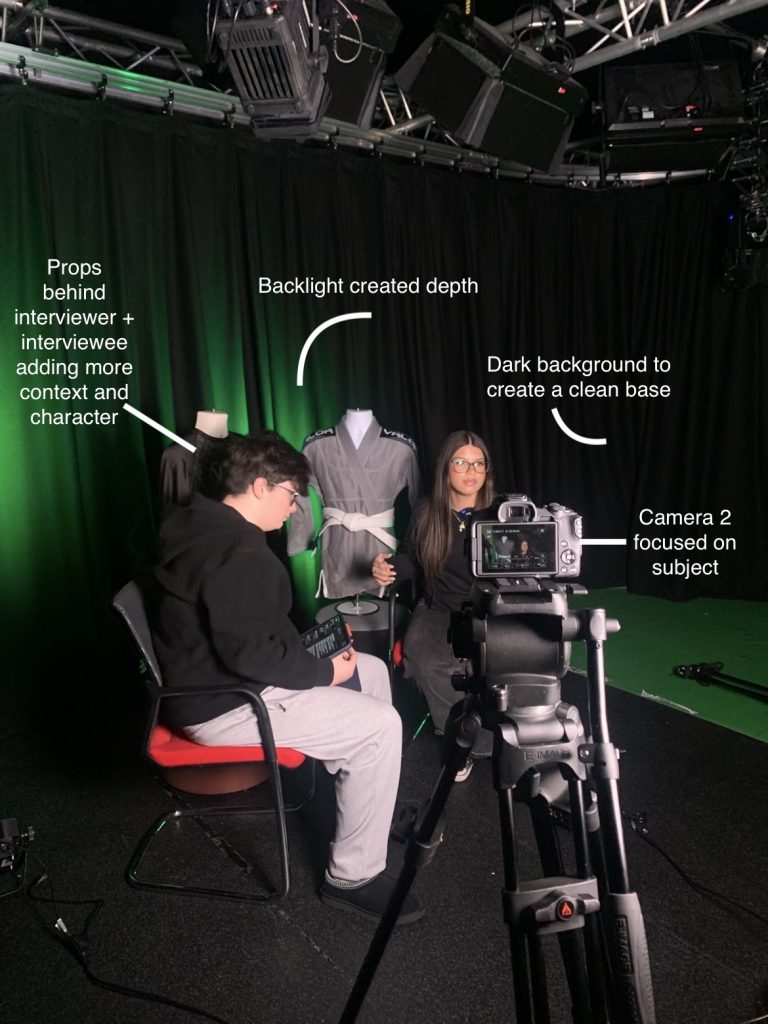
During recording I ensured the microphone was positioned close enough to capture clear audio while avoiding background noise.
After filming, I edited the video using Adobe Premiere Pro, where I:
- synced the external microphone audio with the video footage
- cut between camera angles
- removed unnecessary pauses to make the video cleaner
This editing process helped create a smooth and professional final interview.
Evaluation and Reflection
What Went Well
- The audio quality was clear and professional, especially compared to using only the camera microphone.
- The two-camera setup made the video more engaging and allowed smoother cuts during editing.
- The background and scene selection helped keep the focus on the interview while still supporting the topic of Brazilian Jiu Jitsu.
Even Better If
- Next time I would include practical lights in the background, such as lamps, to create more atmosphere.
- Spending more time on colour correction during editing would help ensure the shots from both cameras match perfectly.
- I could experiment with more dynamic camera angles to make the interview visually stronger.
Leave a Reply