
Context
This week I completed the full creation process of my audio documentary “The Tap Out,” which focuses on the evolution of women in Brazilian Jiu-Jitsu — from being overlooked in a male-dominated sport to becoming world-level competitors, coaches, and cultural leaders.
My target audience is 15–30-year-olds, especially women who are interested in sports culture, empowerment stories, martial arts communities, and real human journeys. This age group prefers documentaries that feel emotional, informative, and relevant, so I aimed to create something with depth but also a modern, youthful tone.
The goal of my documentary was to create an inspiring and educational long-form audio piece that shows how women fought for space, respect, and recognition in BJJ, and how the sport has grown as a result. I wanted it to feel like a mix between sports journalism and personal storytelling.
Research
Technical
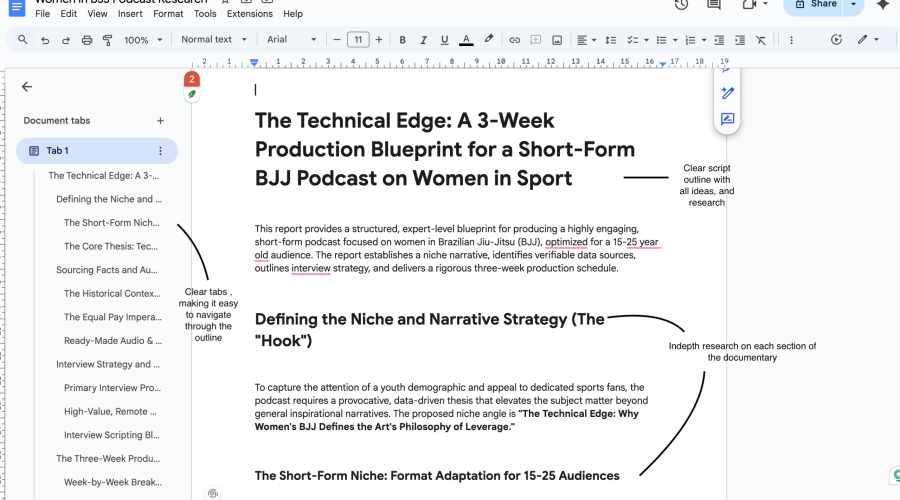
I used Gemini as my primary research tool because it allowed me to gather large amounts of information quickly, with strong detail and clarity. Compared to doing research manually, Gemini helped me summarise long articles, find connections between ideas, and understand complex concepts more efficiently.
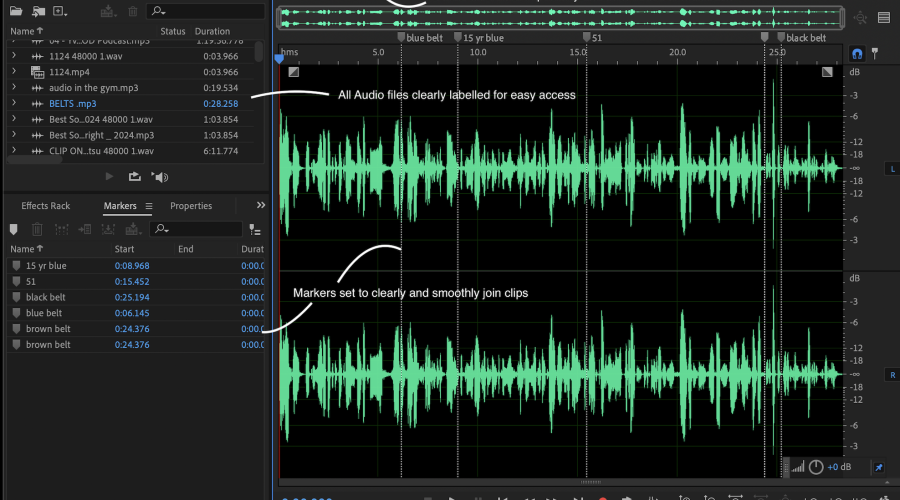
Before recording or editing, I researched how to create a clean, professional audio documentary using Adobe Audition. I looked at online manuals, tutorials, and voiceover guides to understand exactly how to set up and edit my documentary.
I used an Audio-Technica microphone inside a sound-treated radio studio, which allowed my voice to sound controlled. An alternative would have been recording at home, but that would have created background noise and more editing work.
Story
My approach was to build the documentary from a human perspective, showing what women experienced, how attitudes changed, and what the sport looks like today. My biggest inspiration came from female-led sports podcasts and short storytelling pieces, such as “The Game Changers,” “Burn It All Down,” and “Game On.” These sources focus heavily on emotion, identity, and personal voice — which matched my topic much better.
I began by creating a script outline, which helped me map out the introduction, main points, emotional beats, and ending message of my documentary. I looked at how other student documentaries, like “The Boot Room” and professional short-form documentaries, build tension, present information, and keep the audience engaged. I looked at how to balance facts with storytelling, how real interviews can be included, and what type of tone matches my documentary theme.
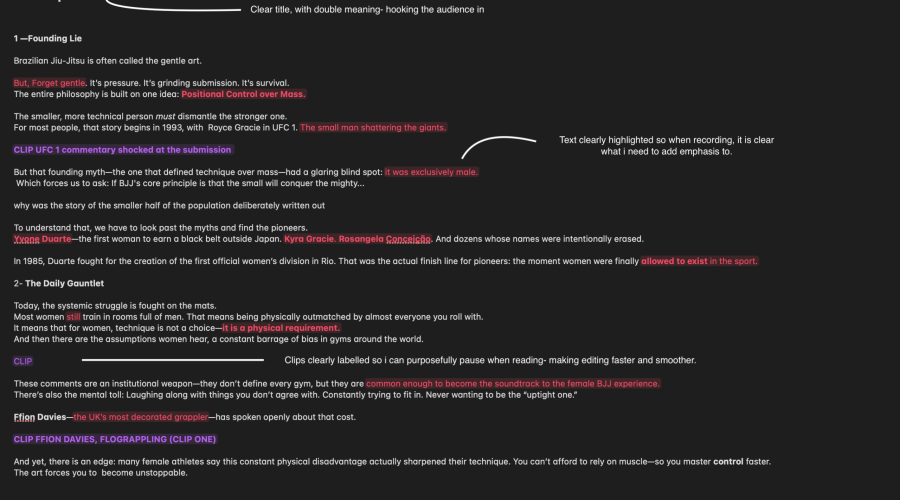
I then moved on to writing my first full script draft based on the research. This gave me a clearer idea of the pacing, transitions, and the message I want the audience to walk away with. My script included the parts I found most important—early challenges, key pioneers, changes in competition, and the strong female presence in BJJ today—while removing anything which was repetitive.
Style
I wanted the documentary to feel modern, emotional and intimate, similar to the tone of young-adult storytelling platforms like BBC Three Docs, and women-in-sport podcasts. These examples use engaging narration, personal stories instead of just facts, and steady pacing.
Because my audience is young, I avoided a formal or news-report style. Instead, I used, conversational language, short descriptive moments (avoided long dates, etc.), and subtle SFX (gym ambience, light training sounds)
These stylistic choices help the listener stay connected to the story, especially during emotional sections where I wanted the narration to breathe and feel personal.
Practical Skill
Find below screenshots with the following things included:
Planning & Writing
- Created my full script outline
- Wrote the full documentary script
- Structured it into clear chapters
Editing in Adobe Audition
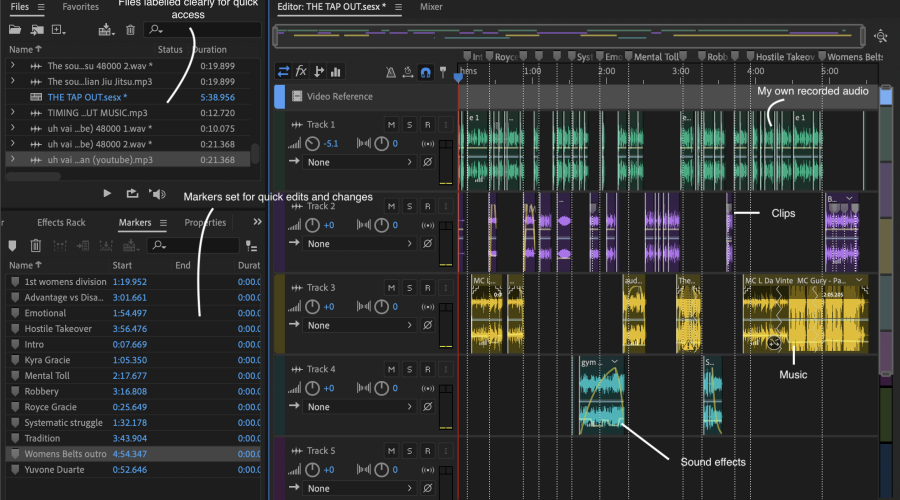
- Set up a multitrack session
- Layered narration, music beds and SFX
- Cut pauses, mistakes and repeated words
- Removed breaths and mouth noises
Evaluation and Reflection
What Went Well:
- I had a strong research foundation, as Gemini helped me gather long, detailed information quickly, which strengthened my understanding of the topic.
- My narration tone matched the subject, making emotional sections feel authentic and real.
- The final mix sounded clean and professional, with well-balanced beds, SFX and voice levels.
Even Better If:
- Slowing some narration slightly to let emotional points land more strongly.
- Looking at more documentary examples would help me plan transitions and shot ideas more confidently.
- Some parts can still be made more engaging or emotional; further editing will improve flow and impact.
Leave a Reply