
Context
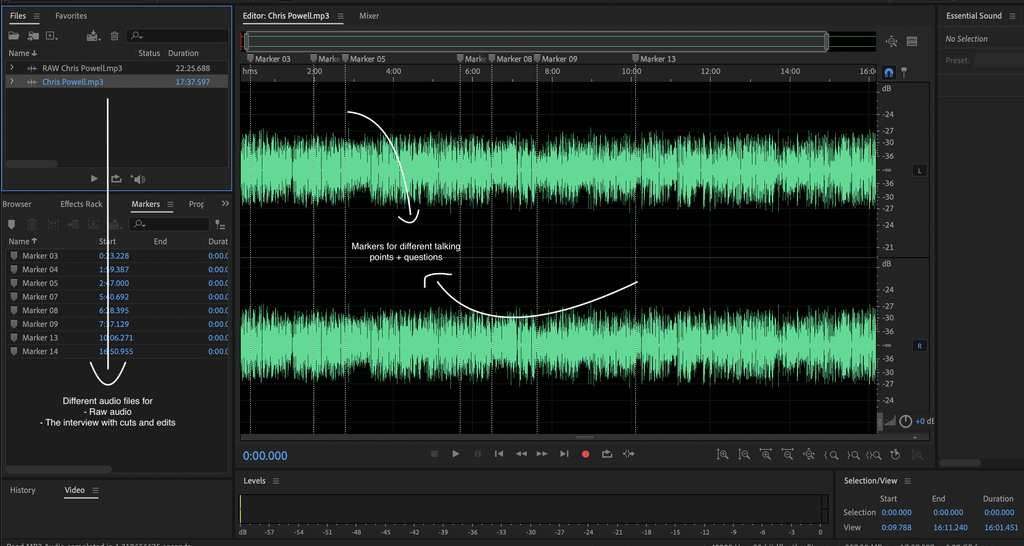
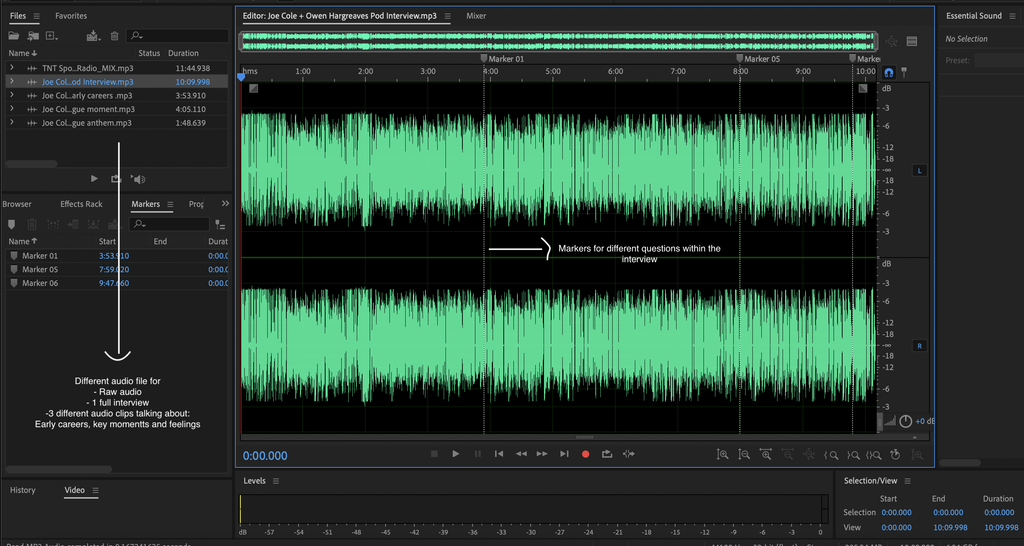
This week I focused on audio interview editing, working on two different professional sports interviews in Adobe Audition. The first featured Chris Powell, discussing his football career as well as his experience with prostate cancer. The second featured Joe Cole and Owen Hargreaves, discussing their careers, Champions League memories and experiences within professional football.
My target audience was mainly sports fans aged 20–35, particularly people who consume football interviews, podcasts and sports radio content. So I wanted both pieces to be clear, well-paced and easy to follow, while still adapting the tone to the subject being discussed.
Research
Technical
For both projects, I used Adobe Audition because the tasks were completely focused on audio. Audition gave me precise control over cutting dialogue, arranging sections, adjusting levels and creating a clean final mix.
I mainly worked within the Multitrack Editor, where I could arrange different pieces of audio non-destructively and listen to how my edits worked together.
For my hardware, I used a MacBook Pro for both, as it is suitable for Audition
Story
For the Chris Powell interview, I try my best to keep the natural progression between his experiences in football and his discussion surrounding prostate cancer. Rather than removing every pause to make it quicker, I needed to consider whether a pause was adding meaning to what was being said.
The Joe Cole and Owen Hargreaves interview had a much more conversational football focus. They discussed their early careers, Champions League memories and what the competition meant to them. So all I did was mostly organise the interview so each topic felt distinct while still sounding like one natural conversation as both guests started asking eachother questions.
Stylistic
For the Joe Cole and Owen Hargreaves piece, I wanted a more energetic sports broadcast feel. Their personalities and football memories needed to remain central, so I avoided over editing the conversation and concentrated on making transitions between subjects feel natural.
The Chris Powell interview had a slightly different tone. When the subject moved towards prostate cancer, I wanted the edit to become more reflective and measured rather than maintaining the same fast sports radio pace throughout.
My aim was to keep the accessibility of modern sports media while allowing the subject matter to control the tone.
Problem Solving
| Problems | Solutions |
| Removing too much from an interview could change the meaning of an answer or make speech sound unnatural. | listened to the sentences before and after every major edit. Instead of cutting purely based on silence in the waveform, I considered what the speaker was actually saying and whether the pause served a purpose. |
| The conversation moved from football into the much more serious subject of prostate cancer, meaning one editing pace wouldn’t work throughout. (Chris interview) | I allowed more space around important statements during the serious sections while tightening some of the lighter football discussion. |
| Their interview had several different jokes with each other, which could make the finished piece feel disconnected, as the listener wouldn’t understand. (Joe Cole + Owen Hargreaves) | I found the main subjects and organised the material so the conversation progressed logically, rather than simply keeping everything in |
Planning & Production
Pre-production/planning
Because I was provided with already recorded interviews, my planning was mainly editorial rather than production-based.
Before making detailed edits, I listened through the recordings to understand what was being discussed. I identified the strongest sections and considered which moments could be removed without losing important context.
Production
I did not record the original interviews, so there was no traditional filming or recording stage for me this week.
Post-Production
For the Chris Powell interview, I used Adobe Audition to remove unnecessary sections, tighten speech and improve the overall flow while being careful around the more personal parts of the conversation.
For Joe Cole and Owen Hargreaves, I focused more heavily on structure, removing unnecessary material and making the different football discussions flow together naturally.
Across both projects, I repeatedly listened back to edits to check that cuts weren’t noticeable and that sentences still sounded natural.
Distribution
The finished pieces were created as part of my coursework and portfolio, but their format would be content that could realistically be distributed through sports radio, podcasts, broadcaster websites, or online audio platforms.
Practical Skills
This week mainly developed my audio editing and editorial decision-making skills in Adobe Audition.
Evaluation & Reflection
| What Went Well | Even Better If |
| Working on two interviews gave me more confidence using Adobe Audition, especially when cutting dialogue, removing unnecessary sections and making edits sound natural. | Next time, I would map out the strongest sections of each interview before beginning detailed editing. This would make my workflow quicker and give me a clearer idea of the final structure. |
| I organised the Joe Cole and Owen Hargreaves interview so the different topics, such as their early careers and Champions League experiences, flowed naturally rather than feeling like separate pieces of audio. | I could experiment more with compression and level balancing so the finished interviews don’t just flow well editorially but also have a more consistent broadcast-quality sound. |
| I approached the two interviews well. The Chris Powell interview required a more sensitive and reflective pace, while the Joe Cole and Owen Hargreaves interview could be quicker and more energetic. | I could spend more time listening back to the complete edit to identify sections that are either too fast or unnecessarily long. |